Thursday, 21 November 2013

Wikipedia sends cease-and-desist letter to PR firm offering paid edits to site


Online encyclopaedia bans Wiki PR from editing its clients' entries via 'sockpuppet' accounts
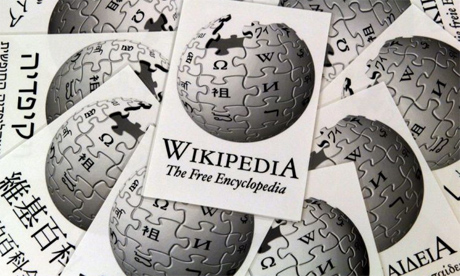
wikipedia logos
Wikipedia says the ban of Wiki PR could be lifted if it pledges to adhere 'as closely as possible' to its editing policies. Photograph: Boris Roessler/EPA
Wikipedia has sent a cease-and-desist letter to a Texas PR company that offers to help clients by editing entries on the online encyclopaedia in their favour.
It follows an investigation lasting more than a year by Wikipedia's own volunteer editors, which suggested that Wiki PR, based in Austin, Texas, had created more than 300 "sockpuppet" accounts – fake profiles set up by people and companies – to edit entries about clients.
Wiki PR has been banned from editing entries on Wikipedia since October because its paid advocacy breaches the site's terms of use. Thelatest move from Wikipedia's executive director Sue Gardner raises the stakes by banning any use of sockpuppet accounts that might have been created by the company.
The move against Wiki PR is part of growing efforts by Wikipedia to block paid advocacy and "sockpuppets" on the site, which has grown since its beginning in January 2001 to encompass more than 30m articles written in 290 languages.
Its importance rests on the fact that Wikipedia is often linked to as the source of information elsewhere on the web. That makes it highly ranked in search results: one of its articles will often figure in the top two or three results in a search for a related topic, meaning that people often rely on information they find there.
The law firm retained by Wikipedia accuses the PR company of misusing its trademark on its site, and notes that the ban could be ended if Wiki PR divulges all the sockpuppet accounts it has created, a list of the articles it has edited, and pledges only to edit via disclosed accounts and adhere "as closely as possible" to Wikipedia's editing policies.
On its site, the PR company says that it offers "the easy way to accurately tell your story on Wikipedia". The site's leadership page says that its co-founder, Darius Fisher, "has built Wiki PR into the largest Wikipedia consulting firm" after realising the importance of Wikipedia entries while working with a crisis communications consultant in San Francisco.
The company's role in editing entries came to light after Wikipedia's own volunteer editors carried out an investigation lasting more than a year which suggested that Wiki PR had created more than 300 "sockpuppet" accounts that were being used to edit entries about companies. Hiring PR companies to edit Wikipedia entries is known as "meatpuppetry".
Among companies whose entries are said to have been edited by the company are those for Priceline and the communications company Viacom
Wikipedia sets great store on the idea that its entries should be presented from a "neutral point of view" and that they should be verifiable from external online sources.
"Sockpuppetry and meatpuppetry are especially harmful when used to disguise secret works of advocacy purchased by clients to promote a particular product, idea or agenda," says Wikipedia's lawyers in the letter to Wiki PR. It adds that the extra editing load required to root out such advocacy "squanders valuable volunteer time, to the detriment of the entire Wikipedia community".
Wiki PR did not respond to a request for comment via email or Twitter.

Tuesday, 19 November 2013

#BBCtrending: Can Twitter save you in a tornado?


click to watch video

Caught up in a major disaster you could cry for help or phone emergency services - should you also tweet?
An initiative called Micromappers has enlisted digital humanitarian volunteers to sift through tweets to help emergency services locate those in need during recent major natural disasters including the Pakistan earthquake and Oklahoma tornado.
Justine Mackinnon explained to #BBCtrending how the method was used to direct UN aid workers in the Philippines after Typhoon Haiyan.
The team is also in talks with Facebook to see if they can use it in a similar way. Its effectiveness remains unclear in areas with lower smartphone and online penetration.

'Selfie' named by Oxford Dictionaries as word of 2013


Pope pictured in a selfieThe Pope posed for this picture with youngsters in August, with the resulting selfie going viral

Related Stories

"Selfie" has been named as word of the year by Oxford Dictionaries.
The word has evolved from a niche social media tag into a mainstream term for a self-portrait photograph, the editors said.
Research suggested its frequency in the English language had increased by 17,000% in the last year, they added.
Other shortlisted words included "twerk" - a raunchy dance move performed by Miley Cyrus - and "binge-watch" - meaning watching lots of TV.
"Schmeat", meaning a form of meat synthetically produced from biological tissue, was also a contender.
'Inventiveness'
The word of the year award celebrates the inventiveness of English speakers when confronted with social, political or technological change.
Oxford Dictionaries online editor Richard Holden explains the choice of "selfie" as word of the year
In 2004, the word of the year was "chav", in 2008 it was credit crunch and last year it was "omnishambles".
To qualify, a word need not have been coined within the past 12 months, but it does need to have become prominent or notable in that time.
Selfie is defined by Oxford Dictionaries as "a photograph that one has taken of oneself, typically with a smartphone or webcam and uploaded to a social media website".
Its increase in use is calculated by Oxford Dictionaries using a research programme that collects around 150 million English words currently in use from around the web each month.
This software can be used to track the emergence of new words and monitor changes in geography, register, and frequency of use.
Papal power
Selfie can be traced back to 2002 when it was used in an Australian online forum, according to Oxford Dictionaries.
Sasha and Malia Obama at their father's inaugurationThe Obama girls take a selfie
A man posted a picture of injuries to his face sustained when he tripped over some steps. He apologised for the fact that it was out of focus, saying that it was not because he was drunk but because it was a selfie.
This year, selfie has gained momentum throughout the English-speaking world, helped by pictures such as one of the Pope with teenagers that went viral.
Judy Pearsall, editorial director for Oxford Dictionaries, said: "Social media sites helped to popularise the term, with the hashtag #selfie appearing on the photo-sharing website Flickr as early as 2004, but usage wasn't widespread until around 2012, when selfie was being used commonly in mainstream media sources."
Selfie was added to the Oxford Dictionaries Online in August, but is not yet in the Oxford English Dictionary, although it is being considered for future use.
Other words that were shortlisted included "showrooming" - examining a product at a shop before buying it online at a lower price - and bitcoin - a digital currency in which transactions can be performed without the need for a central bank.

Monday, 18 November 2013

How online banking has evolved over 30 years


Click to watch video

This week sees the 30th anniversary of the start of online banking in the UK.
Over the years the technology's got faster, smaller and smarter. But what does the future hold?
Technology correspondent Dave Lee has been investigating.

Friday, 15 November 2013

Robot used to round up cows is a hit with farmers

BBC News

A cow eating grassRobots are being used to move cows from fields to the dairy

Related Stories

Robots could be used in the future to round up cows on dairy farms, according to researchers.
A four-wheeled device, known as Rover, has been tested by a team at Sydney University. It was used to move a herd of cows from a field to a dairy.
Researchers were amazed at how easily cows accepted the presence of the robot.
They were not fazed by it and the herding process was calm and effective, they said.
Because the robot moved in a steady manner it allowed cows to move at their own speed which was important in reducing lameness among cattle, Dr Kendra Kerrisk, dairy researcher and associate professor, told the BBC.
Robots are already used in the milking process but the team wanted to see if they could be used in other areas of dairy farming.
The robot was adapted from one that was already being used to monitor fruit and trees on farms. A team at Sydney University's Centre for Field Robotics modified the robot so that it could be put in a field with cows in order for the researchers to gather data on robot-bovine interaction.
The prototype needs to be operated by a human but it's hoped that in the future a version can be developed that will be fully automated.
Extremely excited
As well as herding cows a new version could also collect information useful for farmers.
According to the research team, the robot could be used at night to move slowly through the maternity paddock monitoring cows that are due to calve. It could also be used to gather data on soil and detect problems with electric fences.
Cows and milk churnsUsing robots to get cows to the dairy will be better for their well-being say researchers
"The research is in its very early stages but robotic technologies certainly have the potential to transform dairy farming," said Dr Kerrisk.
"When we have discussed this concept with farmers they have been extremely excited and we have had a flurry of calls and emails asking how they can get hold of one," she added.
The robot could also cut down the number of accidents involving humans on farms. Most dairy farmers in Australia use quad bikes to round up their cattle and they are one of the leading causes of injury. The team hopes that by using the robot to do the job instead, accident rates could fall.
Since demonstrating the robot at a dairy symposium in Australia earlier in the year the team has secured funding to develop Rover the robot, mark II.

Experts lobby UN for 'killer robot' ban


Campaigners against the development of fully autonomous weapons, known as "killer robots", have urged the United Nations to draft an global treaty outlawing their use.
Professor Noel Sharkey, from the International Committee for Robot Arms Control, travelled to Geneva to lobby members of the Convention on Conventional Weapons.
It will vote on Friday on whether it should consider imposing a moratorium on unmanned weaponry.
Mr Sharkey told the BBC's Today programme that the launch of pilotless planes like the US navy's X-47B moved the world a step closer to the deployment of fully autonomous weapons.
It made aviation history in July by successfully landing on a aircraft carrier, without any human involvement.

Tuesday, 12 November 2013

The apostrophe

Try the following game from the BBC skillswise website to practise your use of apostrophes.