Thursday, 9 October 2014

Could a big data-crunching machine be your boss one day? (BBC news)


Amelia
Could Amelia, the "learning cognitive agent", be your boss one day?
I'm on a date with Amelia. She's neatly dressed, emotionally intelligent and whip-smart.
But she's a little too virtual for my tastes.
Amelia is a "learning cognitive agent", according to her creators IPSoft - like one of those virtual customer service helpers that pop up on corporate websites.
Only not so dumb and a lot less irritating.
But one day, she could end up being your boss, her makers believe.
Machine learning
Amelia can swallow textbooks whole, speak 20 languages, understand concepts and learn from her mistakes. And she can be replicated any number of times.
On my screen I see her absorb a complex engineering manual in 14 seconds then immediately answer questions such as "What are the symptoms of a bent drive shaft?" and "What causes high power demand?"
This may be a far cry from Scarlett Johansson's uber-intelligent operating system Samantha in Spike Jonze's sci-fi film, Her, but it's the future, says Chetan Dube, IPSoft's chief executive.
Android hands on a keyboardAre there any limits to what robots could do in the workplace?
Read the article here

Wednesday, 8 October 2014

Mars mission: Could US girl, 13, be first on red planet? (BBC NEWS)


Alyssa Carson has big dreams. At the age of 13 she is determined to be the first person to land on Mars.
But this is more than wishful thinking - Nasa thinks she stands a chance and she is already in training.
Alyssa is studying science and several languages and became the first person to attend all three of Nasa's world space camps. Her call sign at the US space agency is "Blueberry".
The teenager from Baton Rouge, Louisiana, says failure is not an option. And her father says he has the next 20 years of work planned out.


Tuesday, 7 October 2014

Alien attacks and Fifa 15 chants: The art of video game noise


Sound design is often the unsung hero of video games. But when developers get it right, primal instincts are triggered, helping immerse players in the action. Below, the brains behind the soundscapes of five of this year's biggest releases discuss their art in exclusive interviews with the BBC:

Read article here

Monday, 6 October 2014

Big robot fleet takes to UK waters (BBC news)

Drones of the Deep


A fleet of marine robots is being launched in the largest deployment of its kind in British waters.
Unmanned boats and submarines will travel 500km (300 miles) across an area off the southwestern tip of the UK.
The aim is to test new technologies and to map marine life in a key fishing ground.
In total, seven autonomous machines are being released in a trial heralded as a new era of robotic research at sea.
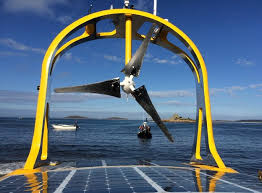
Two of the craft are innovative British devices that are designed to operate for months using renewable sources of power including wind and wave energy.
The project, led by the National Oceanography Centre, involves more than a dozen research centres and specialist companies.

Thursday, 2 October 2014

3D-printed hand first for Inverness girl


Five year old Hayley Fraser, from Inverness, was born without fully-formed fingers on her left hand.
Her parents David and Zania Fraser sought help from US-based E-nable, a network of volunteers who design and make prosthetics mainly for children.
Hayley's pink hand was designed from a plaster cast made by her parents.
E-nable's members include engineers, artists and university academics.
Printing in 3D has been described as the "future of manufacturing" and is increasingly being used to make everything from film props to food.
The technology is also being used to make aerial drones for use in civilian roles and parts for motor racing cars.

Wednesday, 1 October 2014

Getting units right


Getting units right is important. Scientists from NASA will tell you this. In 1998 a space probe called the Climate Orbiter was launched to track climate changes on Mars. The Orbiter failed to stop at the atmosphere of Mars, and instead carried on going, only to burn up and disintegrate. On investigation it was found that the company that built the spacecraft, Lockheed, were using the Imperial units of measurement - miles, feet and inches - while the people running the missions at NASA were using the metric system - kilometres, metres and centimetres. Calculations by Lockheed and NASA didn’t match at all and the mission failed miserably - costing more than $125 million and years of effort.


Source  future learn course Electrify (University of Liverpool)